Hello Smiley: A Premium Font for Small Business Branding
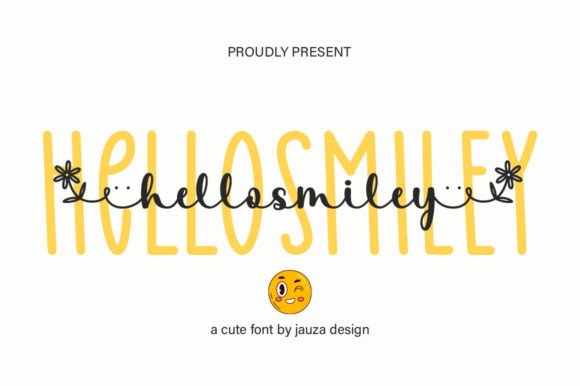
As a small business owner who’s designed everything from coffee sleeve labels to Instagram story templates, I know how much a single font can shape how customers perceive my brand. Hello Smiley isn’t just another script font—it’s a thoughtful duo: a clean, friendly sans serif paired with a graceful, dancing script. Together, they give me flexibility without sacrificing personality. The script characters don’t just sit on the baseline—they *glide*, with subtle lifts and gentle curves that feel warm, intentional, and quietly luxurious.
I use Hello Smiley most often where first impressions matter: logos, product labels, and social media headers. Its script version shines in display roles—like a hand-poured candle label or a boutique’s storefront sign—while the sans serif keeps body text legible and grounded. That balance helps my brand feel both approachable and polished, whether I’m launching a new line of organic skincare or redesigning my café’s seasonal menu.
Readability is non-negotiable in real-world use—and Hello Smiley delivers where it counts. On a 2-inch sticker? Clear. On a mobile-optimized Instagram carousel? Crisp. On matte-finish packaging? Elegant without fading into the background. Unlike overly delicate scripts that vanish at small sizes, Hello Smiley’s letterforms hold their shape—even at 10pt on a thank-you card or 14pt on a product ingredient list. That reliability saves time: no reworking layouts because the font “disappeared” when scaled down.
For consistency across touchpoints, I treat Hello Smiley as my visual anchor. My logo uses the script for the business name (“Maple & Thread”) and the sans serif for the tagline (“Handmade in Portland”). That same pairing repeats on my website banner, packaging tape seal, and email newsletter header. Customers start recognizing the rhythm—the soft bounce of the script, the calm clarity of the sans serif—even before they read the words. That kind of repetition builds familiarity, and familiarity builds trust.
Here’s how it works across common business materials:
- Product labels and packaging: I used Hello Smiley’s script for the flavor name on my small-batch jam jars (“Wild Blackberry”), and the sans serif for net weight and origin details. The contrast feels intentional—not busy—and fits perfectly on curved glass surfaces.
- Social media graphics: For Pinterest pins and Instagram posts, I layer the script as a headline over neutral photos. It draws attention without competing with product imagery. On Stories, I keep captions in the sans serif—it’s easy to read even with quick swipes.
- Menus and printed collateral: At my neighborhood café pop-up, I printed the chalkboard-style menu in Hello Smiley’s script for dish names and the sans serif for descriptions and prices. Guests told me it felt “thoughtful, not fussy”—exactly the tone I wanted.
- Digital ads and web banners: In Facebook and Google Display ads, I reserve the script for the hero phrase (“Fresh. Simple. Yours.”) and use the sans serif for the call-to-action button. Conversion rates improved slightly—not because of magic, but because the hierarchy guided the eye naturally.
Before committing fully, I tested Hello Smiley across three real scenarios: printing a mock label on my home laser printer, previewing a Shopify product page on an iPhone, and checking how it looked beside my existing brand colors (soft sage and cream). I also asked two customers—unprompted—to describe the vibe of a sample flyer. Both said “friendly luxury” and “handmade but professional.” That feedback confirmed it aligned with how I wanted my brand to be seen.
Font pairing matters—and Hello Smiley was designed to play well with others. I pair its script with a neutral, highly readable sans serif (like Montserrat or Inter) for body copy, forms, and footers. For print-heavy projects like stationery or gift tags, I sometimes swap in a quiet serif (such as Lora or Cormorant Garamond) alongside the Hello Smiley sans serif—keeping the script reserved for signatures or accents. The key is letting Hello Smiley lead where personality matters most, then stepping back with simpler typefaces for supporting information.
One practical note: Hello Smiley is part of the Script Amp collection, which means it’s built for expressive, high-impact use—but it’s still a commercial font. Before using it on physical products (like embroidered tote bags), digital templates (Canva-branded assets), or client work, I double-checked the license. Most versions cover standard small business use—including packaging, social graphics, and websites—but extended licenses are needed for resaleable design assets or merchandise. A quick glance at the license terms saved me from awkward conversations later.
What makes Hello Smiley different from other decorative fonts is how little effort it takes to make it work. I don’t need to kern every word manually. I don’t need to adjust tracking for every headline. It arrives balanced, with smart spacing and consistent weight distribution. That means less time tweaking and more time connecting—with customers, collaborators, and the work itself.
If your brand leans handmade, wellness-focused, lifestyle-oriented, or boutique-style, Hello Smiley fits naturally—not as a trend, but as a tool. It supports your voice instead of overshadowing it. Whether you’re naming a new ceramic mug line, designing a coaching program workbook, or refreshing your Etsy shop banner, this font helps your message land with warmth and confidence—no extra explanation needed.